
Wang named 2026 Steenbock Professorship
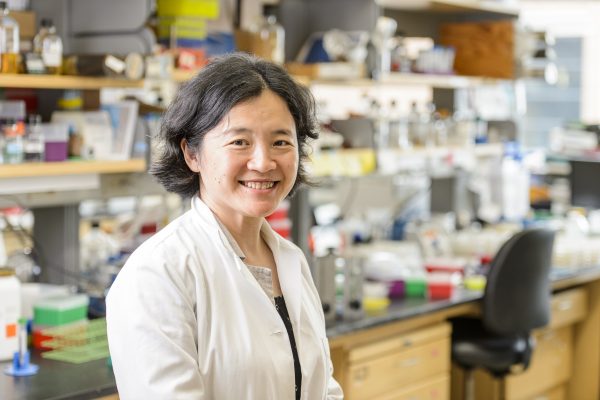 Jue Wang, professor of bacteriology, has been awarded the 2026 Steenbock Professorship in Microbiological Sciences.
The Steenbock Professorship provides research funds to recipients annually for 10 years and honors those faculty who have made major contributions to the advancement of knowledge, primarily through their research endeavors at UW–Madison, but also as a result of their teaching and service activities. The award supports recipients as they explore innovative research directions and new approaches to their research area.
“The Steenbock Professorship is among the most prestigious and important professorships for researchers at the UW–Madison,” says Dorota Brzezinska, vice chancellor for research. “Professor Wang exemplifies the highest ideals of the Steenbock Professorship through her innovative research and her deep commitment to mentoring the next generation of scholars. Her work advances fundamental understanding in metabolomics, transcriptomics and proteomics with biochemical and evolutionary approaches while also translating into meaningful impact exemplifying the Wisconsin Idea. Her dedication to students and trainees fosters a collaborative, supportive environment where emerging scientists can thrive. This combination of research excellence and mentorship makes her especially deserving of this honor.”
Wang holds a Ph.D. from the University of California–San Francisco and completed her postdoctoral research at the Massachusetts Institute of Technology. She joined the UW–Madison faculty in 2012.
In 2023, Wang was elected a fellow of the American Association for the Advancement of Science, the world’s largest general scientific society. She also has been honored with a Romnes Faculty Fellowship sponsored by the Wisconsin Alumni Research Foundation (WARF) and was named a Howard Hughes Medical Institute (HHMI) Faculty Scholar.
Wang’s research aims to answer the following fundamental questions: How do bacteria utilize stress-induced small molecules to adapt to their specific environmental niches? How do bacteria enter a metabolically dormant persister state that is intrinsically tolerant to a broad array of antibiotic treatments? How do stressed bacteria mitigate potential conflicts between their DNA replication and transcription machineries to ensure survival? What are the molecular mechanisms of bacterial evolution to fit their specific niches?
Wang is using powerful data collection approaches to try to answer these questions, and her team combines genetics and biochemistry with high-throughput approaches for understanding the molecular details and network properties of stress signaling, regulation and evolution. The goal is to apply their research to pathogenic bacteria to solve global issues including widespread antibiotic resistance in pathogens.
Specifically, Wang studies these processes in the Gram-positive bacterium Bacillus subtilis and the Gram-negative bacterium Escherichia coli. These organisms grow fast and are highly amenable to genetic manipulation.
In addition to her research, Wang is committed to student success including training the next generation of biologists for diverse careers that leverage world-class expertise in genetic and genomic research. Wang has mentored students ranging from high schoolers through Ph.D. candidates, underrepresented minority students and postdoctoral researchers.
“I am honored to receive the Steenbock Professorship and deeply grateful for the support of my trainees, colleagues, and department,” says Wang. “This recognition reflects the collective efforts of our research community and provides a valuable opportunity to further advance our work on fundamental questions of how microorganisms grow, respond to stress, and evolve. I am especially excited to connect these discoveries to pressing global challenges, including antibiotic resistance.”
By Natasha Kassulke, natasha.kassulke@wisc.edu