
National Security Research and Initiatives
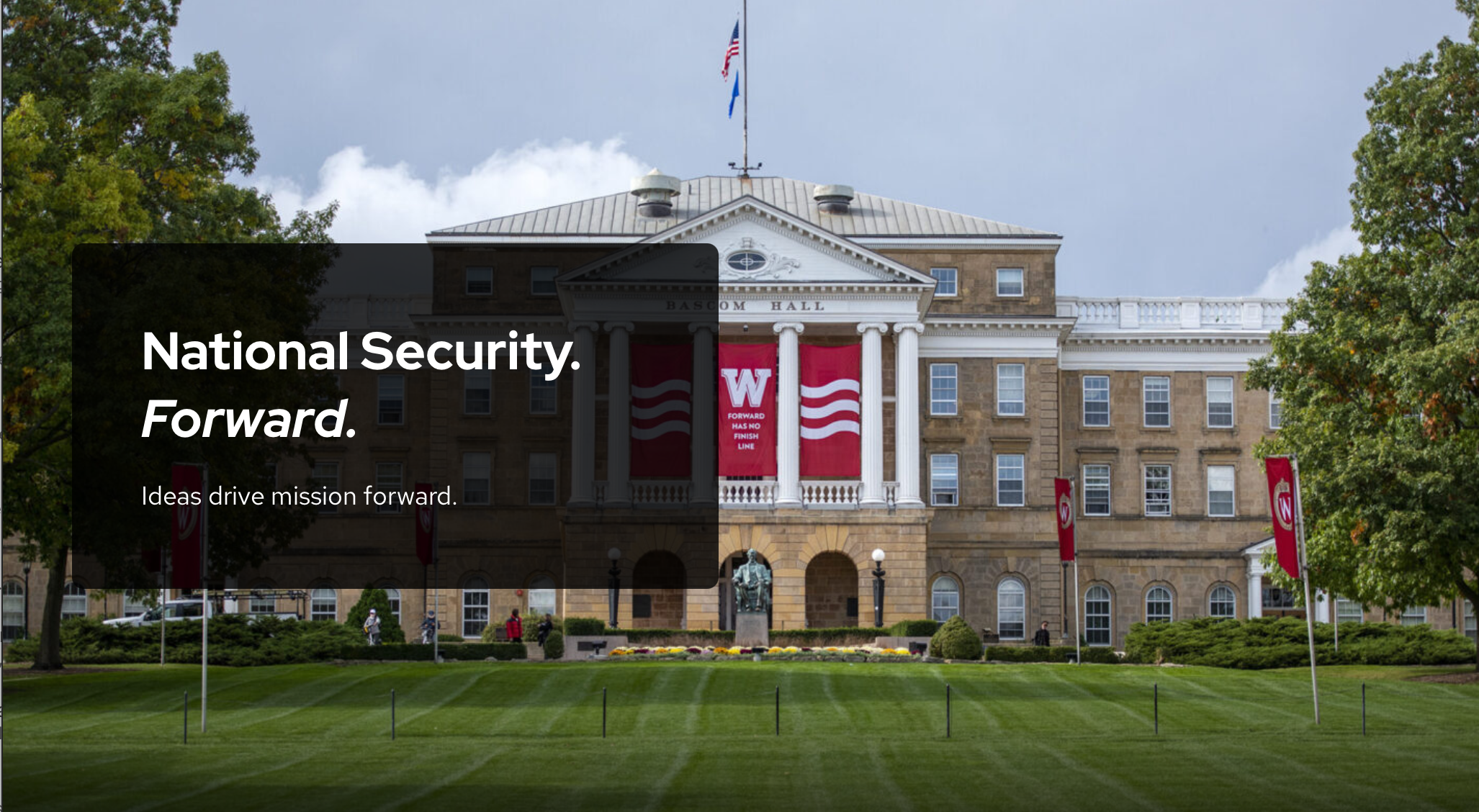
Welcome
$27M WARF investment fuels UW–Madison’s next frontiers in research
This gift aims to accelerate four high-impact research initiatives at the university: quantum technologies, brain health, fusion energy and national security. Thank you to WARF for this transformative gift!
Visit the new web site for the Wisconsin Initiative on National Security (WINS) at https://nationalsecurity.wisc.edu!
The University of Wisconsin–Madison has a legacy of cutting-edge research in the national interest. With our extensive research infrastructure, interdisciplinary expertise, world-class people, and a commitment to addressing the toughest global challenges, UW–Madison contributes significantly to the national security landscape, while enriching our academic and societal impact.
This is a hub for driving interdisciplinary collaborations between universities, industries, government agencies, and national labs to advance national security research, education, partnerships, and workforce development.
Vision and Mission
Vision: Establish UW–Madison as a nationally recognized leader in collaborative, interdisciplinary research and education that actively addresses the most pressing national security challenges.
Mission: Harness UW–Madison’s world-class research capabilities to advance innovative and impactful national security research; cultivate diverse and highly skilled professionals for national security careers; and extend the benefits of our discoveries beyond campus, reflecting the Wisconsin Idea by directly contributing to state and national well-being.
“In today’s complex global environment, federal research partnerships in national security are more critical than ever. We can deepen our impact, expand opportunities for researchers and students, and reinforce our role as a leader in research that safeguards the public good.” — Dorota Brzezińska, Vice Chancellor for Research
“Relationships across the national security enterprise will amplify the university’s voice in critical conversations. Campus strengths will be connected to new partners, bringing UW–Madison’s ingenuity and the Wisconsin Idea to the forefront of the national security landscape.” — Craig Thompson, Vice Chancellor for University Relations
“Federal and industry investment in national security focused technologies, particularly those that have dual civilian use, is accelerating. Universities that move decisively to conduct such research will shape these fields for decades.” — Erik Iverson, CEO, Wisconsin Alumni Research Foundation
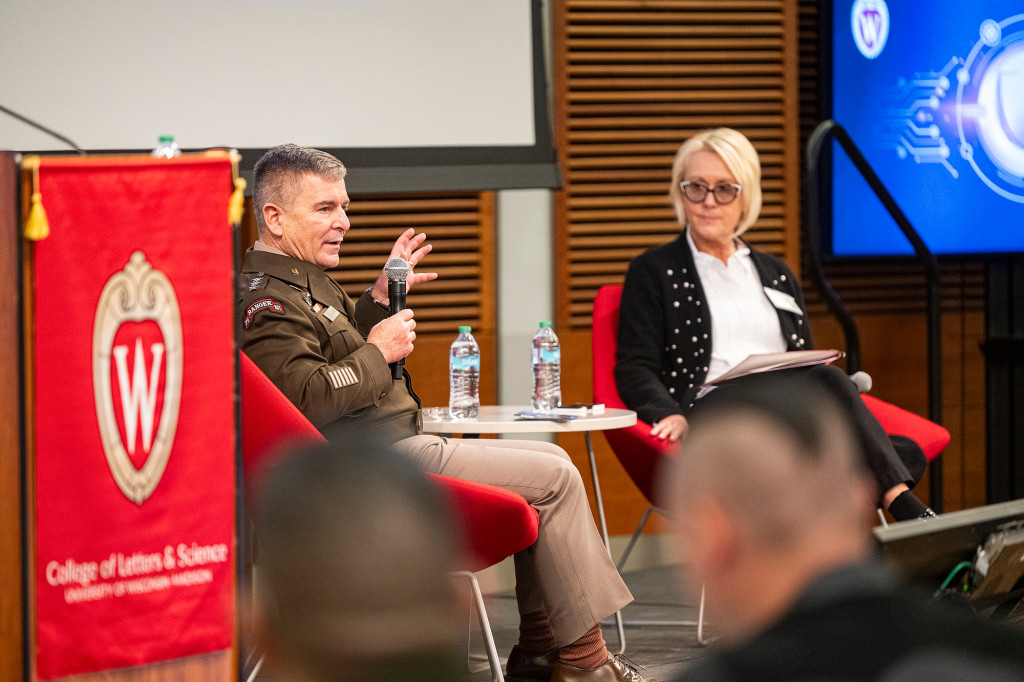
Army Lt. Gen. Joe Hartman, acting head of U.S. Cyber Command and the National Security Agency (NSA), and Dorota Brzezińska, UW–Madison Vice Chancellor for Research, discuss the critical role that academic institutions like UW–Madison play in advancing cyber capabilities, developing new technologies and preparing a capable workforce at the UW–Madison Cyber Research Forum.
Key Functions
- Research Integration: Foster interdisciplinary research collaborations addressing national security challenges.
- Promote Capabilities: Market UW–Madison’s people, facilities, and capabilities in our Core Competencies to national security partners.
- Partnership Expansion: Strengthen national security relationships with federal agencies, state government, industry, and other academic institutions.
- Workforce Development: Develop educational programs and training to prepare students for careers in national security sectors.
Core Competencies
- AI: Leveraging UW–Madison’s interdisciplinary expertise to advance ethical and transformative artificial intelligence applications for national security.
- Cyber: Strengthening cybersecurity through UW–Madison’s comprehensive research and education initiatives that protect critical infrastructure and information systems.
- Quantum: Accelerating quantum technology innovation by harnessing UW–Madison’s leadership in quantum science and engineering to address national security challenges.
- Materials: Pioneering advanced material research at UW–Madison to develop resilient, high-performance solutions critical to defense and security applications.
- Energy: Leveraging UW–Madison’s extensive expertise in energy research, processes, and platforms, from internal combustion engines to cutting-edge fusion energy technologies.
- Space: Utilizing UW–Madison’s space science and spacecraft engineering capabilities to support secure and innovative space and satellite technologies.
- Health: Applying UW–Madison’s renowned biomedical research strengths to protect public health, advance service member care, and enhance biosecurity preparedness.
-
Agriculture: Harnessing UW–Madison’s expertise to safeguard domestic food systems, anticipate and mitigate disruptions, and create resilient food security policies and technologies.
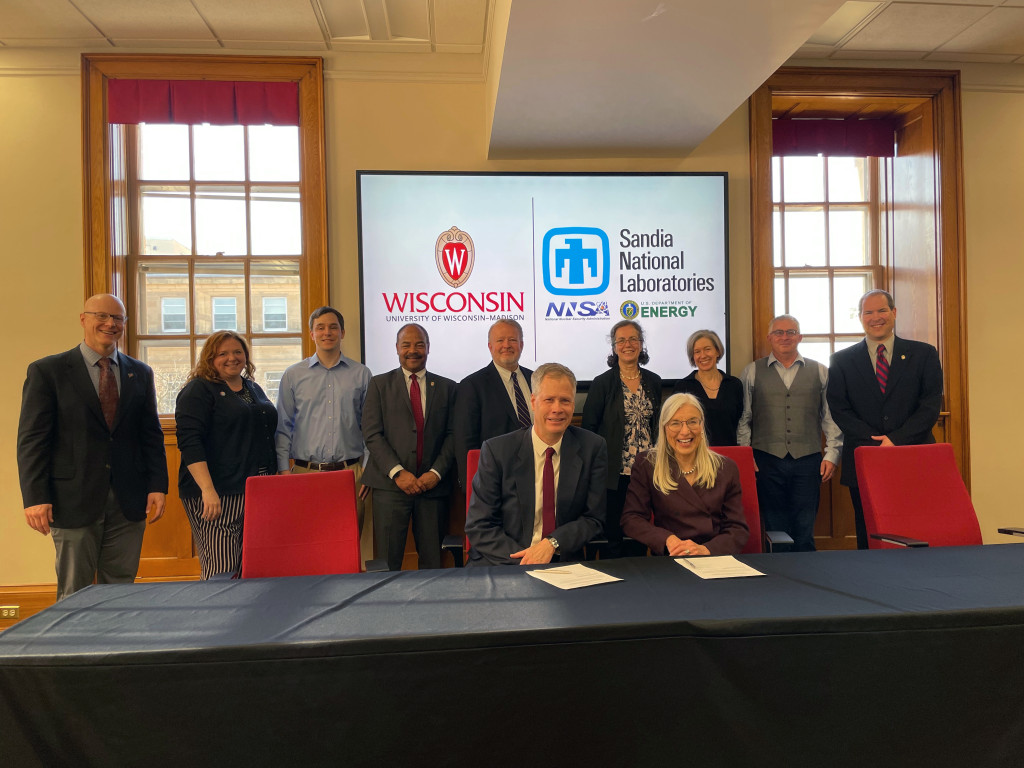
Leadership from UW–Madison and Sandia National Laboratories celebrate the signing of a memorandum of understanding (MOU) between the two institutions.
Example Partnerships
Intelligence and Security University Research Enterprise (INSURE)
→ AI Research to Improve How We Find and Use Critical Information
Sandia National Laboratories (SNL)
→ UW–Madison and Sandia National Laboratories expand strategic partnership
Argonne National Laboratory (ANL)
→ Exploring Decades of Semiconductor Collaboration between Argonne National Lab & UW–Madison
National Nuclear Security Administration (NNSA)
→ UW-Madison engineers part of consortium to support nuclear security and nonproliferation
U.S. Cyber Command (CYBERCOM) Academic Engagement Network (AEN)
→ UW–Madison Joins U.S. Cyber Command’s Academic Engagement Network
→ U.S. Cyber Command visit highlights UW–Madison’s leadership in cyber research and education
National Security Agency (NSA)
→ UW–Madison Awarded Prestigious National Center of Academic Excellence for Cyber Research Designation
U.S. Army AI Integration Center (AI2C)
→ For Army scholars, an MS in Data Engineering offers advanced training in a high-demand field
U.S. Army Civil Affairs and Psychological Operations Command (Airborne)
→ UW–Madison and U.S. Army Civil Affairs
→ UW–Madison, U.S. Army announce partnership on environmental issues
U.S. Army Engineer Research and Development Center (ERDC)
→ UW–Madison and U.S. Army ERDC Launch Strategic Education Partnership to Accelerate National Security Research
→ ERDC partners with UW-Madison and NPS to advance historic preservation
Defense POW/MIA Accounting Agency (DPAA)
→ UW MIA Recovery and Identification Project
→ How a UW-Madison project uses science, history to bring MIA soldiers back home
Office of Naval Research (ONR)
→ PANTHER — global leader in traumatic brain injury detection and prevention
→ How might pulsed microwaves harm the brain?
Strategic Benefits
- Enhanced Research Opportunities: Participation in national security research opens avenues for increased funding and collaboration with federal agencies on topics of national importance, with dual-use applications that go beyond national security.
- Workforce Development: Engaging in national security-related projects prepares students and researchers for careers in high-demand sectors, bolstering the university’s role and contributions to national security and high-tech workforce development.
- Reinforcing the Wisconsin Idea: By contributing to national security, UW–Madison extends our commitment to public service and our responsibility as a public land-grant research institution, aligning with our mission to improve lives beyond the campus.
“UW–Madison is among our nation’s crown jewels as a land-grant public research university, with a long and proud legacy of conducting groundbreaking research in the national interest.” — Dave Schroeder, Director of National Security Initiatives
Resources
Resources for UW–Madison faculty, staff, and students:
- National Security Google Group — an email group for sharing national security research and funding opportunities
- National Security Student Google Group — an email group for sharing student national security research, internship, and fellowship opportunities
→ UW–Madison National Defense Society — student group for those interested in national security, defense technology, and industry networking - National Security Microsoft Team — a team for collaborating on national security research news and current events
- Research Security — information and resources about research security, export control, and compliance requirements
- Wisconsin Security Research Consortium (WSRC) —a non-profit corporation led by the Wisconsin Technology Council, the science and technology advisor to the Governor and Legislature, which enables sensitive national security research and industry needs
→ Resources for researchers — links to agencies, solicitations, and other information about national security research
→ Resources for military — resources for Active Duty, Guard, and Reserve military service members at UW–Madison - National Security Studies Certificate — 15-credit undergraduate certificate that explores U.S. national security
News
- WARF announces total 2026 support for UW-Madison research — WARF News, Sep 10, 2026
- $27M WARF investment fuels UW–Madison’s next frontiers in research — UW News, Aug 25, 2026
- UW strengthens defense ties amid funding uncertainty — Daily Cardinal, Apr 23, 2026
- Tom Still: More defense research in Wisconsin can apply to civilian issues, too — WisPolitics, Apr 10, 2026
- UW–Madison Day in Washington, DC, 2026 — Wisconsin Alumni Association News, Apr 3, 2026
- Cyber Badger 2026 Explores AI-Enabled Cyberattacks — UW Cyber News, Mar 22, 2026
- UW–Madison and U.S. Army ERDC Launch Strategic Education Partnership to Accelerate National Security Research — UW Research News, Mar 11, 2026
- A UW Boost for National Security — OnWisconsin, Spring 2026
- Infleqtion Becomes First Neutral-Atom Quantum Company to Go Public — Infleqtion, Feb 17, 2026
→ WARF Ventures is proud to support Infleqtion, a global leader in quantum sensing and computing with deep ties to the University of Wisconsin-Madison. Infleqtion’s leadership includes University of Wisconsin–Madison Department of Physics Professor Mark Saffman, Chief Scientist for Quantum Information, and the company regularly collaborates with UW researchers at the Wisconsin Quantum Institute. - UW–Madison top 5 in national research ranking, surpasses $1.93B in research expenditures — UW News, Dec 23, 2025
- UW-Madison wants to conduct more research with the Department of Defense — Wisconsin State Journal, Nov 10, 2025
- UW fostering closer research ties with federal defense, cybersecurity agencies — UW News, Oct 16, 2025
- Dave Schroeder named UW–Madison’s Director of National Security Initiatives — UW Research News, Aug 18, 2025
- UW–Madison hosts DHS Corporate Security Symposium — WSRC News, Aug 9, 2025
- UW-Madison research is $1.7B operation ready to grow, new leader says — Cap Times, Jan 6, 2025
Events
- The Autonomous Heartland Comes to Wisconsin, Sep 6, 2026, Lambeau Field, Green Bay, WI
- MaGIC 2026 — 14th meeting of the Machine-Ground Interaction Consortium, Sep 22-24, 2026, Madison, WI — register now
Past Events
- Sandia National Laboratories Research Office Hours, Apr 15, 2026, UW–Madison, Madison, WI
- DARPA Mission Connect at the University of Michigan — May 7, 2026, Ann Arbor, MI — register now
- Wisconsin Drives Manufacturing Summit, Jun 1-2, 2026, Lambeau Field, Green Bay, WI — register now
- DARPA BTO Innovation Opportunity Fair (BIO Fair), Jun 5, 2026, Tysons, VA — register now
- Defense Manufacturing Conference (DMC), Mar 30-April 2, 2026, Orlando, FL
- Wisconsin Governor’s Cybersecurity Summit, Apr 7-8, Appleton, WI
- Defense Industrial Base Conference 2026 (DIBCON26), Apr 7-9, 2026, Hyatt Regency Milwaukee, WI
- DARPA Fleetwood Industry Day, Mar 12, 2026
- USCYBERCOM/NSA Cyber and SIGINT Summit, Mar 4-6, 2026, Ft Meade, MD
Contact

Dave Schroeder, PhD
Director of National Security Initiatives
Email: dave.schroeder@wisc.edu
Phone: 608-444-5672
General email: nationalsecurity@wisc.edu
 Dave Rothamer, PhD
Faculty Director
Associate Dean for Research, College of Engineering
Robert Lorenz Professor of Mechanical Engineering
Email: rothamer@wisc.edu