Awards and special recognition
PostedFebruary 4, 2026
 Left: Morton Ann Gernsbacher, Vilas Research Professor and Sir Frederic C. Bartlett Professor of Psychology, has been awarded the internationally renowned Oswald Külpe Prize for her outstanding work on cognitive processing.
Presented biennially by the Institute of Psychology at Julius-Maximilians-Universität Würzburg since 2005, the prize celebrates exceptional contributions to experimental research on higher mental processes.
Read the story here.
Matt Sinclair receives Department of Energy Early-Career Award
 Matt Sinclair, assistant professor in the University of Wisconsin–Madison Department of Computer Sciences, has received a US Department of Energy Early Career Award in recognition of his pioneering research in computer architecture and high-performance computing (HPC) systems. The honor, which supports exceptional early-career faculty poised to make significant impacts in their fields, is among the most competitive federal research awards given to scholars in many fields, including computer scientists. Sinclair is the first person in the Computer Sciences department to be given this distinction.
Read the full story here.
Schroeder leads Wisconsin National Guard 176th Cyber Protection Team
 Capt. David Schroeder has been named commander of the 176th Cyber Protection Team following the unit’s formal change of command ceremony Jan. 10 , 2025 at the Armed Forces Reserve Center in Madison, Wis. During the ceremony, Capt. Robert Saffell relinquished command of the unit to Schroeder.
Schroeder is the Director of National Security Initiatives in the Office of the Vice Chancellor for Research. Schroeder also continues to serve as a Cyber Warfare Officer and Military Intelligence Officer in the Wisconsin National Guard, focused on state and national cyber efforts. He previously served as a Cryptologic Warfare Officer in the Navy Reserve in the special operations community.
Read the story here.
Department of Pediatrics Woodring receives prestigious NIH Pediatric Scientist Development Program (PSDP) award
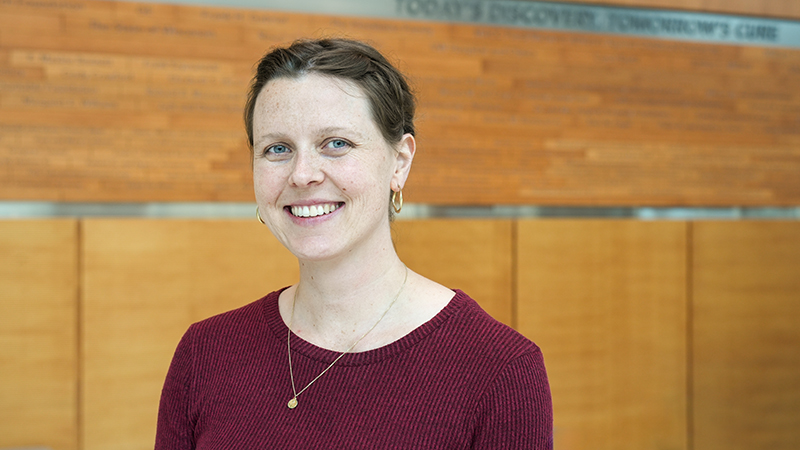 Tess Woodring is the first pediatrics trainee in department history to receive a prestigious NIH Pediatric Scientist Development Program (PSDP) award. Partially funded through the National Institute of Child Health and Human Development (NICHD), the Pediatric Scientist Development Program began in 1986 to promote and support early pediatricians with an MD, DO, or MD/PhD who are committed to a career in scientific research — academic medicine. The program provides two to three years of training for trainees with mentors in established laboratories all over the country where they are afforded substantial support and protected laboratory time.
Read the full story here: https://www.pediatrics.wisc.edu/department-of-pediatrics-fellow-therese-tess-woodring-selected-for-pediatric-scientist-development-program/
Ten interdisciplinary translational research teams receive catalyst pilot awards
Translational research seeks to turn biomedical research discoveries into health solutions through the application of translational science. The Institute for Clinical and Translational Research (ICTR) helps move clinical discoveries into practice by providing pilot awards to researchers. These pilots support small-scale tests of methods and procedures to assess whether an approach can be used in a larger-scale study.
One of ICTR’s funding opportunities, the Translational Basic and Clinical Research (TBCR) Pilot Award, supports projects focused on developing new clinical interventions, integrating translational research into an investigator-initiated project, or addressing contemporary and/or emerging health crises. Reflecting ICTR’s commitment to developing interdisciplinary teams, TBCR-supported projects must include co-principal investigators from different scientific disciplines.
“Translational research is about momentum,” says Alan McMillan, PhD, ICTR Pilot Awards Program co-director. “These awards provide the essential fuel to move ideas out of the lab and toward the clinic, where they can directly improve human health.”
Since 2007, ICTR has released 17 opportunities to apply for the TBCR pilot projects. Awards have supported 187 Contact PIs and their interdisciplinary teams. To date, 72 PIs (38.5%) have collectively secured one or more external grants directly attributable to their pilot project. These grants are primarily from federal sources (NIH, VA Merit, DOD, and NSF) totaling $68,939,847, representing a substantial return on this investment.
Read the story here.
