
Roundup of campus research news
A Year of Resilience and Discovery
Despite uncertainty over federal funding, the university’s scientific community continued to advance knowledge and improve lives.
Find out how from some of these UW–Madison 2025 research stories, ranging from a dinosaur discovery to a game-changing clinical trial for kidney transplant patients.
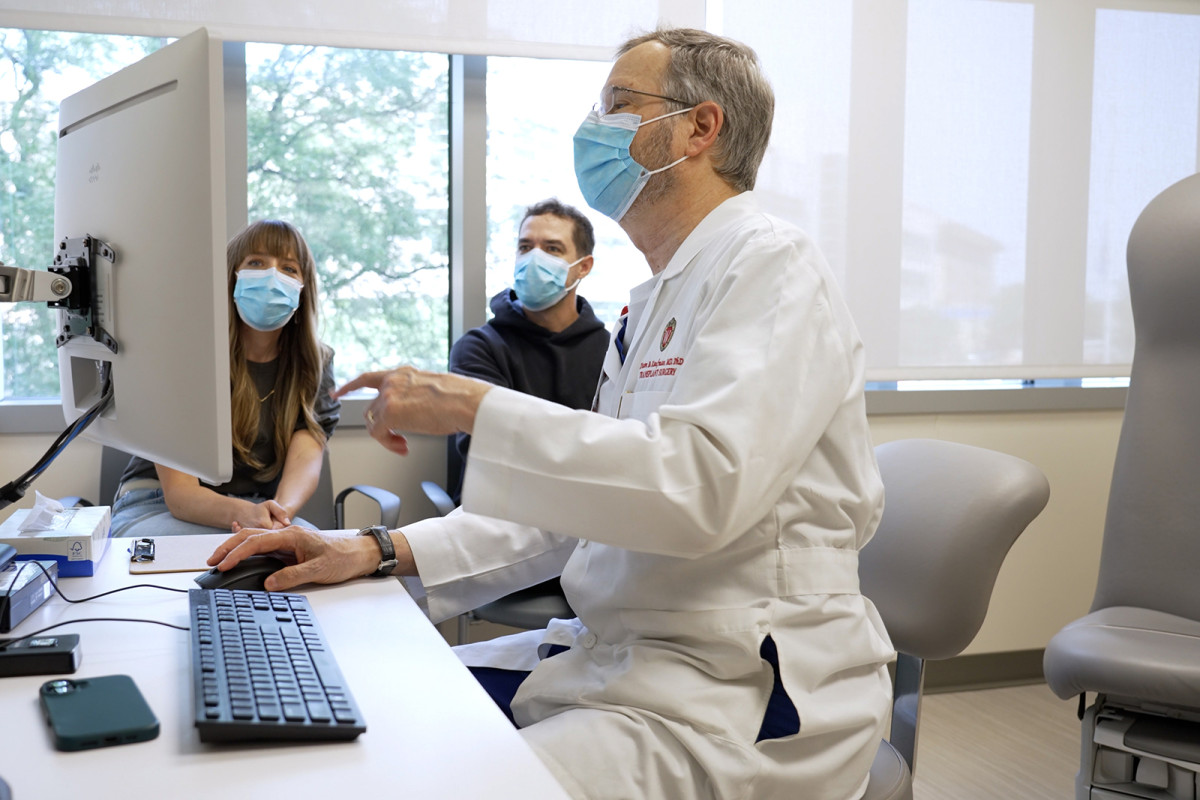
Photo below: Dr. Dixon Kaufman leads a UW clinical trial that transplants stem cells from the kidney donor to the recipient, removing the need for anti-rejection medication.
Powering progress: Engineer, inventor earns national recognition for transforming electric motors
The National Academy of Inventors (NAI) has included a University of Wisconsin-Madison electrical engineer in its 2025 class of fellows—the highest distinction designed to recognize academic inventors’ accomplishments in patents, licensing and commercialization.
Daniel Ludois, the Jim and Anne Sorden professor of electrical and computer engineering and the research and innovation director of the Wisconsin Electric Machines and Power Electronics Consortium (WEMPEC), is breaking new ground in electric motor technology.
Ludois’ work focuses primarily on integrating novel materials, designs and techniques to enhance and create electrical and electromechanical power conversion devices across many different scales, from massive power grids to industrial automation and vehicles.
Ludois is developing new classes of power converters that use less of the copper and steel that conventional electrical systems rely on so heavily.
Read the full story here: https://engineering.wisc.edu/news/powering-progress-engineer-inventor-earns-national-recognition-for-transforming-electric-motors/
Ten interdisciplinary translational research teams receive catalyst pilot awards
Translational research seeks to turn biomedical research discoveries into health solutions through the application of translational science. The Institute for Clinical and Translational Research (ICTR) helps move clinical discoveries into practice by providing pilot awards to researchers. These pilots support small-scale tests of methods and procedures to assess whether an approach can be used in a larger-scale study.
One of ICTR’s funding opportunities, the Translational Basic and Clinical Research (TBCR) Pilot Award, supports projects focused on developing new clinical interventions, integrating translational research into an investigator-initiated project, or addressing contemporary and/or emerging health crises. Reflecting ICTR’s commitment to developing interdisciplinary teams, TBCR-supported projects must include co-principal investigators from different scientific disciplines.
“Translational research is about momentum,” says Alan McMillan, PhD, ICTR Pilot Awards Program co-director. “These awards provide the essential fuel to move ideas out of the lab and toward the clinic, where they can directly improve human health.”
Since 2007, ICTR has released 17 opportunities to apply for the TBCR pilot projects. Awards have supported 187 Contact PIs and their interdisciplinary teams. To date, 72 PIs (38.5%) have collectively secured one or more external grants directly attributable to their pilot project. These grants are primarily from federal sources (NIH, VA Merit, DOD, and NSF) totaling $68,939,847, representing a substantial return on this investment.
This year, ICTR is pleased to support ten projects through NCATS support and co-funding from sponsoring UW–Madison schools, departments, or centers.
Read more about the newly funded innovative projects.
Reviving Ancient DNA to Prepare for Life’s Future
Astrobiologist Betül Kaçar spends much of her time looking for signs of life in other worlds. Some of this is done in the more expected way—analyzing telescope data for biological signatures in the atmospheres of distant, giant exoplanets. But these days, she’s more focused on smaller-scale evidence of how life thrived in environments very different from today’s Earth. She finds it surprisingly close to home, in ancient DNA maintained within present-day earthly microorganisms.
In this video from The Well, Kaçar talks about why this ancient DNA holds a record of how life persisted in the hostile environment of Earth’s deep past. “Evolution keeps a record of biology solving problems,” she says. “So when you study organisms that have been around for a long time…ultimately you are going to be studying their survival strategies.”
In Kaçar’s lab at the University of Wisconsin–Madison, her team uses synthetic biology techniques to re-activate sections of ancient DNA and place microbes in high-CO2 environments closer to what their ancestors encountered 3 billion years ago. After coaxing the microbes to behave as they might have in the deep past, the team can then add stressors—from excess heat to nutrient scarcity—to see how the ancient DNA aids the organisms’ responses and evolution, in order to learn whether some of life’s old genetic tricks might have future uses. This could involve re-engineering and repurposing enzymes and metabolic processes to create crops that deliver nitrogen more effectively.
Read the full story here: https://www.templeton.org/news/reviving-ancient-dna-to-prepare-for-lifes-future
Building Strong Marketing Strategy for WCER’s Fee-for-Service Option
As federal research funding constricts, Wisconsin Center for Education Research (WCER) projects are exploring alternative revenue streams to sustain their work, including development of fee-for-service offerings — work that leverages researcher expertise but depends on clients choosing to purchase it in a competitive marketplace. To help researchers explore this path, Jen Savino, owner and CEO of KW2 Marketing in Madison, recently delivered a presentation on how to build a strong, research-informed marketing strategy.
Savino, who has spent more than 30 years working with higher education, nonprofits, and mission-oriented organizations, grounded her talk in a message resonant for academic audiences. She stressed that marketing is not advertising — it is the process of creating and communicating value in a way that leads to an exchange. Every WCER project already creates value through its work; the task now is to communicate that value intentionally to potential clients, she said.
“It’s the difference between hustling and hustling with a purpose,” said Savino. “Strategy turns hustle into results.”
Read the full story here: https://www.wcer.wisc.edu/news/detail/building-strong-marketing-strategy-for-wcers-fee-for-service-option
UW BIRCWH Program Announces New Scholar Cohort
The Building Interdisciplinary Research Careers in Women’s Health (BIRCWH) program is proud to announce its 2025–27 cohort of scholars. This announcement follows the program’s successful renewal for an additional five-year cycle by the NIH earlier this year. The following assistant professors have been named to the program: Minh Tung Phung, PhD, MPH (Population Health); María Virumbrales-Muñoz, PhD, MS (Obstetrics and Gynecology); and Wenhui Zhou, MD, PhD (Radiology). BIRCWH scholars receive interdisciplinary mentoring, curricular and research support to advance their careers in women’s health and/or sex differences research.
Learn more: https://ictr.wisc.edu/news/new-faculty-scholars-in-womens-health-welcomed-into-uw-bircwh-program/
Cutting-Edge Program Powers Frontline Emergency Care Research
The Emergency Department Research Coordinator Program enables the safe, efficient conduct of research studies at UW Health emergency departments, with access to 250,000 patients and visitors eligible to participate in research each year. Its specialized team of research coordinators and nurses works in tandem with frontline care teams to deliver a range of complex, time-critical services including patient screening and enrollment, data and biospecimen collection, and quality oversight. The EDRC Program welcomes new investigations in acute medical, surgical, and psychiatric emergencies, as well as for complex, undifferentiated conditions.
Read the full story here: https://emed.wisc.edu/news/from-bedside-to-breakthrough-inside-the-cutting-edge-program-powering-emergency-care-research-at-uw-health/
Wisconsin’s Rural Schools Confront Teacher Shortages: UW–Madison Study Explores Challenges, Solutions
A recent working paper from the Wisconsin Center for Education Research (WCER), part of UW–Madison’s School of Education, highlights the persistent challenges rural schools face in attracting and retaining teachers — while also examining how educator preparation programs across the state are working to strengthen the pipeline of future educators.
The paper, “The Current and Future Educator Workforce in Wisconsin’s Rural Schools,” is co-authored by Jenny Seelig of NORC, an independent, nonprofit research institute at the University of Chicago, and Bradley Carl, co-founder and co-director of WCER’s Wisconsin Evaluation Collaborative, with funding provided by UW–Madison’s Tommy G. Thompson Center for Public Leadership. The paper provides a detailed look at both the declining rural educator workforce and ongoing efforts to prepare tomorrow’s teachers.
Teacher shortages in rural schools affect more than staffing numbers: they shape the educational experiences of students across the state, the researchers noted. When schools struggle to fill positions, students may face larger class sizes, fewer course offerings, and limited access to specialized instruction. By strengthening partnerships between districts and educator preparation programs, Wisconsin can build a more sustainable educator pipeline supporting both current and future teachers.
“With stronger support from educator preparation programs and state-level policies, these efforts can be scaled and sustained to ensure every student in Wisconsin, no matter where they live, has access to well-prepared teachers,” said Seelig.
Read the full story here: https://www.wcer.wisc.edu/news/detail/wisconsins-rural-schools-confront-teacher-shortages-uwmadison-study-explores-challenges-solutions
New Research Reveals Online Food Delivery Is Reshaping How Americans Cook—and Their Health
A new study led by Yash Babar, assistant professor of operations and information management at the Wisconsin School of Business, finds that the rise of online food delivery platforms like Grubhub, UberEats, and DoorDash is changing the way Americans eat at home, with measurable impacts on health.
The research reveals:
- Less home cooking: Households spend significantly less time preparing meals at home when delivery services are available.
- Potential health effects: Reduced cooking is associated with higher population-level BMI, suggesting that delivery platforms may be influencing physiological outcomes.
- Context matters: The impact varies depending on local restaurant density, household composition (such as number of children), when people cook, and economic conditions.
“This isn’t just about the convenience of delivery or pickup over dining in restaurants. It’s about how technology is reshaping daily routines like cooking and eating out, with ripple effects for public health,” said Babar.
Read the full story here: https://business.wisc.edu/news/new-research-reveals-online-food-delivery-is-reshaping-how-americans-cook-and-their-health/