
LZ Gets a New Look at Neutrinos from the Sun’s Core with UW–Madison’s Support
By Natasha Kassulke
The LUX-ZEPLIN (LZ) Collaboration has set a World’s Best in the hunt for galactic dark matter at its detector operating deep underground (4,850 ft) at the Sanford Underground Research Facility in the Black Hills of South Dakota. It is the most sensitive particle detector in the world.
The UW–Madison’s Physical Sciences Lab (PSL) played a central role in the design and construction of LZ. From approximately 2014 until the detector was commissioned in September of 2020, PSL provided chief engineering, ultra-high purity xenon handling systems, ultra-high vacuum and cryogenics expertise, specialized fabrication and testing services, and on-site installation and integration.
Recently, the LZ experiment analyzed the largest dataset ever collected by a dark matter detector. Dark matter, the invisible substance that accounts for 85 percent of the mass in the universe, is hiding all around us – and figuring out exactly what it is, remains one of the biggest questions about how our world works.
The record-breaking results provide the strongest constraints yet on low-mass WIMPs, proposed dark matter particles. In addition, the experiment detected boron-8 solar neutrinos, a milestone in the detector’s sensitivity and a window into the behavior of fundamental particles and stars.
PSL continues to support LZ operations today, providing engineering support, equipment maintenance, and continued development efforts on the high purity gas handling systems.
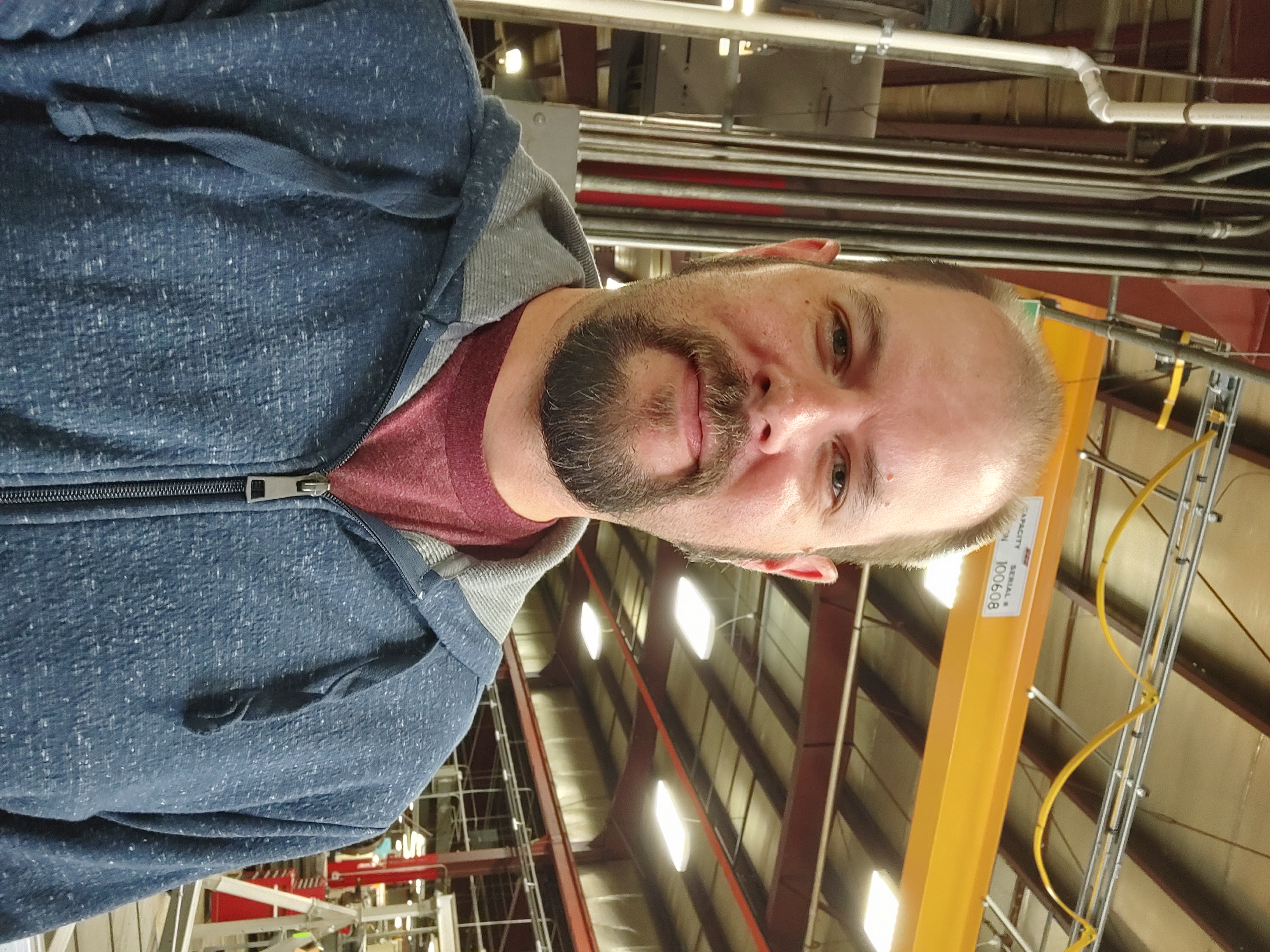
Terry Benson inside the shop at the Physical Sciences Lab.
” LZ was extremely difficult to design and build. We relied on the semiconductor industry for components to use in the design of the high purity xenon systems, but even then, we still had to develop new hardware and techniques to meet purity requirements,” explains Terry Benson, director of PSL. “Delivering specialized hardware and working with the LZ technical teams to get it all working — and keep it working — has been incredibly rewarding for our staff and students.”
Currently, PSL is providing LZ operations with: Equipment maintenance and supply chain support for the xenon gas compressors; development of improved manufacturing processes for critical consumable; and engineering support on xenon handling systems and slow controls.
“PSL is also excited to be part of the next generation liquid xenon dark matter experiment,” says Benson. “XLZD builds on the experience of LZ and two other world-leading xenon dark matter communities: XENON and DARWIN.”
LZ is an international collaboration of 250 scientists and engineers from 37 institutions. The detector is managed by the Department of Energy’s Lawrence Berkeley National Laboratory.
Precise calibration and an improved understanding of their detector let LZ scientists observe a neutrino signal from the sun that can mimic dark matter interactions, marking the detector’s first glimpse of the “neutrino fog.”
The new results use the largest dataset ever collected by a dark matter detector and have unmatched sensitivity.
“We have been able to further increase the incredible sensitivity of the LUX-ZEPLIN detector with this new run and extended analysis,” said Rick Gaitskell, a professor at Brown University and the spokesperson for LZ. “While we don’t see any direct evidence of dark matter events at this time, our detector continues to perform well, and we will continue to push its sensitivity to explore new models of dark matter. As with so much of science, it can take many deliberate steps before you reach a discovery, and it’s remarkable to realize how far we’ve come. Our latest detector is over 3 million times more sensitive than the ones I used when I started working in this field.”

The LUX-ZEPLIN main detector in a surface lab before installation underground.
Credit: Matthew Kapust/Sanford Underground Research Facility
Dark matter has never been directly detected, but its gravitational influence shapes how galaxies form and stay together; without it, the universe as we know it wouldn’t exist. Because dark matter doesn’t emit, absorb, or reflect light, researchers have to find a different way to “see” it.
“When I step back and consider what we’ve achieved – a world-leading search for these low-mass WIMPs using the faintest signals we can see with our detector – it’s extremely rewarding, and the perfect demonstration of the experiment working as it should,” said David Woodward, a scientist at Berkeley Lab and deputy operations manager for LZ. “The result is possible because of diligent work to keep the experiment operating and collecting high-quality data over several years. It’s a team effort, with each individual bringing their care and expertise.”
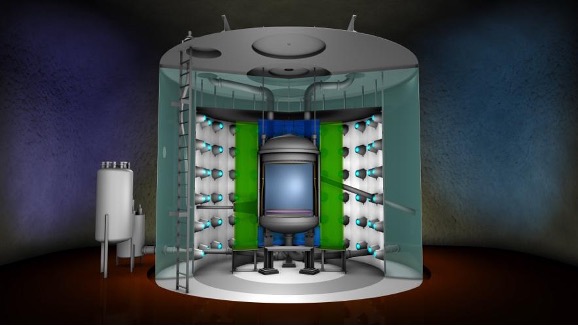
LZ uses a cylindrical chamber full of liquid xenon to look for dark matter. It is surrounded by additional layers to detect or block background particles. When a WIMP or neutrino collides with a xenon atom (right), the xenon atom emits a flash of light and electrons. The light is detected at the top and bottom of the liquid xenon chamber. An electric field pushes the electrons to the top of the chamber, where they generate a second flash of light. Valid WIMP or neutrino interactions cause no signal in the additional layers.
Credit: Greg Stewart/SLAC National Accelerator Laboratory

LZ’s central detector was assembled in a surface cleanroom and moved to the nearly mile-deep campus at the Sanford Underground Research Facility. The underground location shields the experiment from cosmic rays.
Credit: Matthew Kapust/Sanford Underground Research Facility
LZ is supported by the U.S. Department of Energy, Office of Science, Office of High Energy Physics, and the National Energy Research Scientific Computing Center, a DOE Office of Science user facility. LZ is also supported by the Science & Technology Facilities Council of the United Kingdom; the Portuguese Foundation for Science and Technology; the Swiss National Science Foundation; the Australian Research Council Centre of Excellence for Dark Matter Particle Physics; and the Institute for Basic Science, Korea. Thirty-seven institutions of higher education and advanced research provided support to LZ. The LZ collaboration acknowledges the assistance of the Sanford Underground Research Facility.