Research news roundup for December
Smart farming: UW‘s statewide network of hyper-local weather stations gives Wisconsin growers a powerful tool to reduce costs and improve yields.
By Chris Barncard
“When you dial down and focus on ways to support the farmers in our very diversified agricultural economy in Wisconsin, what they require feels familiar to a scientist,” says Chris Kucharik, University of Wisconsin–Madison professor of agronomy. “It’s detailed information, different types of support tools, data-based models to help them guide their decision-making.”
Kucharik is the director of a team of meteorologists, engineers, web developers and technicians building out Wisconet, a statewide network of high-quality weather stations providing valuable, local data to farmers.
Read the full story here: https://news.wisc.edu/smart-farming/?utm_medium=email&utm_source=wordpress_insideuw&utm_campaign=facstaff_comms&utm_content=2025_12_04
Detecting and Preventing Digital Abuse: UW researchers are protecting survivors from cyber stalkers.
An abuser who has access to another person’s phone for even a few minutes can set up automation routines that share location or texting information, enabling them to control a phone, take unauthorized videos, and impersonate their partners. Jaime Espinoza
After identifying vulnerabilities in popular apps that can make it easy for an abuser to stalk individuals with little risk of detection, a team of UW–Madison engineers and computer scientists are developing an online service to find this covert abuse on digital devices.
The team has students to thank for the discovery. Rahul Chatterjee MS’15, an assistant professor of computer sciences, and his research group operate the Madison Tech Clinic, an initiative staffed by volunteer UW students and faculty to aid survivors of domestic and intimate partner violence and other technology-facilitated abuse.
Clinic volunteers discovered some abusers used automation apps, like Apple Shortcuts, to quickly and easily take over digital devices. Because of the nature of these apps, the digital intrusions were difficult for users to detect.
Read the full story here:
https://onwisconsin.uwalumni.com/detecting-and-preventing-digital-abuse/
UW–Madison School of Pharmacy Professor Lingjun Li is awarded the Catherine E. Costello Award for Exemplary Achievements in Proteomics from the US HUPO Association Awards for 2026
In the announcement of US HUPO Association Awards for 2026, UW–Madison School of Pharmacy Professor Lingjun Li is a recipient of the Catherine E. Costello Award for Exemplary Achievements in Proteomics. The award recognizes an individual who has made significant discoveries and scientific achievements in the field of proteomics. Dr. Li will receive her award and present at the US HUPO Annual Conference in February in St. Louis.
Read the full story here:
https://us-hupo.org/Exemplary-Achievements
Wisconsin Opioid Overdose Response Center (WOORC), expands its life-saving work
The first center of its kind in the nation, Wisconsin Opioid Overdose Response Center (WOORC), expands its life-saving work to reduce opioid deaths. Housed at the School of Pharmacy, Associate Professors Cody Wenthur and Jay Ford, co-directors and founders, reflect on the center’s impact during its first year.
Read the full story here:
https://pharmacy.wisc.edu/2025/11/10/doing-the-woorc-to-save-lives/
Full-Day 4K Students in Madison Public Schools See Better Learning Outcomes Than Peers in Half-Day 4K Program
MEP’s newest research brief for Madison public schools shows full-day 4K students learning more.
 By Karen Rivedal, Office of Research & Scholarship
For the first time since full-day, four-year-old kindergarten (4K) began in the Madison Metropolitan School District, a new evaluation by researchers from UW–Madison and the district shows “strong evidence” suggesting students in the full-day 4K program learn more over the school year than their peers attending half-day 4K.
The report from the Madison Education Partnership (MEP) — a research collaboration between the district and the Wisconsin Center for Education Research in the university’s School of Education — revealed “significantly greater” learning growth in the 2023–2024 school year for full-day 4K students in assessments of literacy, numeracy and social-emotional skills, such as managing emotions and relating well with others.
Read the full story here:
Field Day Blends Art and Science for Video Games That Teach, Engage
UW–Madison Research Lab+Game Studio Launches Game, Selects Concept for Another
By Karen Rivedal, Office of Research & Scholarship

Project Hercules, Field Day’s newest game, invites players to step into the shoes of Astrid, an astronomer in the year 2098.
Field Day’s newest game is Project Hercules, an astrophysics primer that invites players to become Astrid, an astronomer working in the year 2098 to identify objects in the night sky and uncover the mystery of an impending celestial event. The game uses research from WIPAC’s IceCube Neutrino Observatory.
Making LAZY plants stand up: Research reveals new pathway plants use to detect gravity.
A study by researchers at the University of Wisconsin–Madison has revealed a previously unknown pathway plants use to detect gravity and orient the direction they grow in. Publishing in Proceedings of the National Academy of Sciences, the study may one day open the door for improvements in crop cultivation.
Prior studies have already established that a suite of genes, nicknamed LAZY, control a pathway plants use for detecting gravity. In a typical plant, cells within the stem use LAZY genes to detect the force of gravity. The plant can then guide the stem to grow upwards, branches to grow outwards, and roots to grow downwards. These controlled directions of growth help a plant optimize its shape for energy production, stability and overall survival.
Read the full story here:
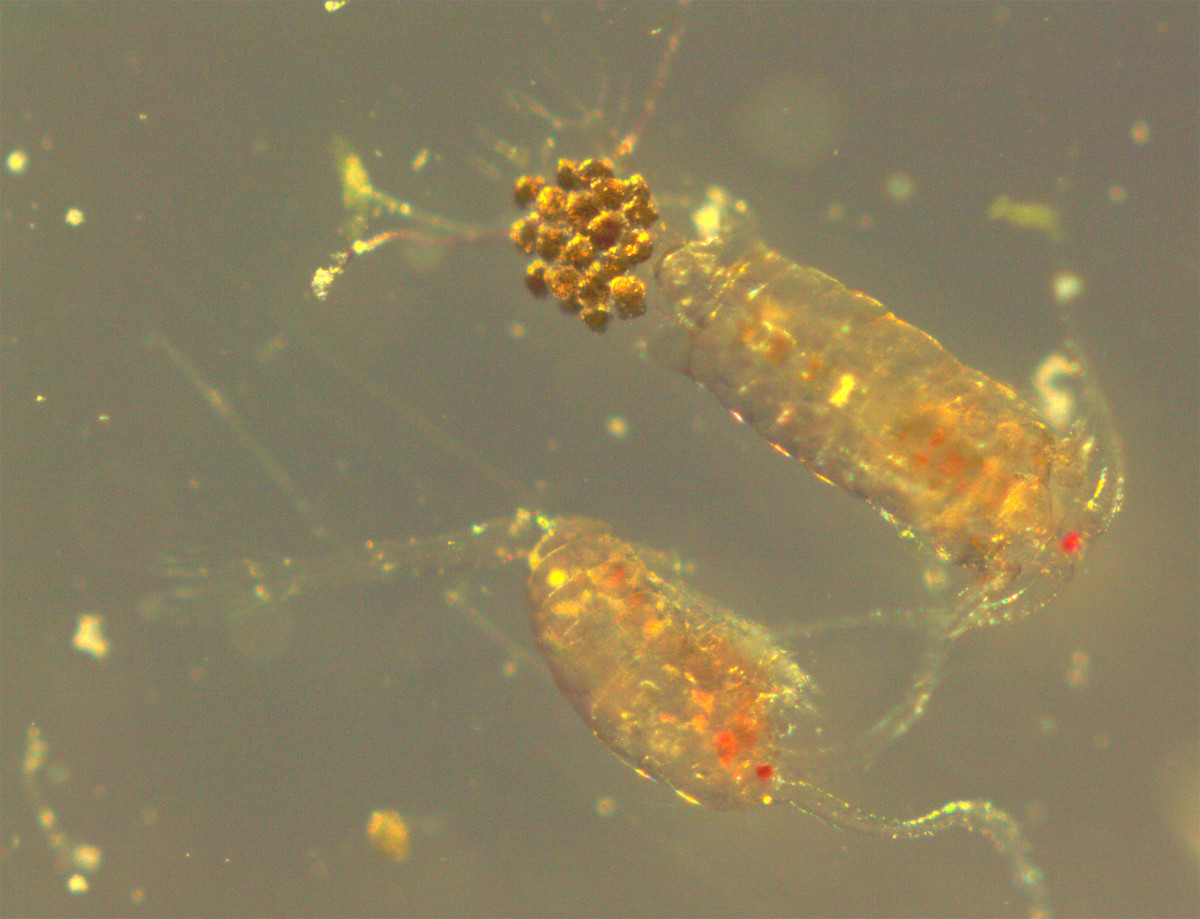
UW researchers turn to the tiny copepod for a big discovery, showing that gene location influences natural selection
A new study by researchers at the University of Wisconsin–Madison provides the first empirical evidence connecting the chromosomal location of genes to natural selection, indicating the arrangement of genes can influence how quickly populations can adapt to rapid environmental change.
Published in the journal Nature Communications, the study analyzed the genomes of three sibling copepod species (Eurytemora affinis species complex) to map how certain mutations — called chromosomal fusions — moved the location of genes as the tiny aquatic crustaceans evolved. The research team was surprised to find that even though these fusions occurred millions of years ago, they have implications for a contemporary species’ ability to adapt.