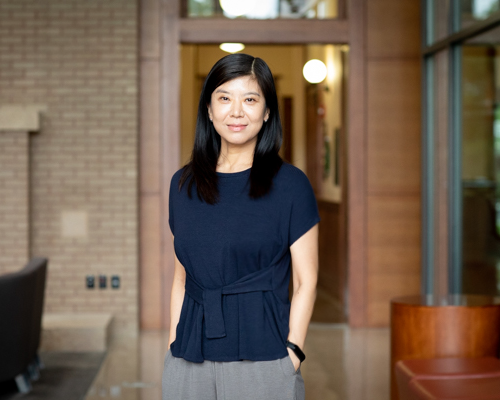
Neugebauer Receives High Risk, High Reward New Innovator Award
With support from the National Institutes of Health 2026 High Risk, High Reward New Innovator Awards, University of Wisconsin–Madison biochemistry professor Monica Neugebauer is exploring nickel-dependent enzymes that can drive new-to-nature chemical reactions.
Neugebauer’s lab focuses on discovering and engineering metalloenzymes — enzymes that contain a metal — and harnessing their power. By helping to speed up chemical reactions, her group’s work creates new possibilities for building complex molecules and expanding the scope of the field of synthetic chemistry.
UW–Madison professor selected as Association for the Study of Higher Education Fellow
By Amellia Fowler
Wang
UW–Madison’s Xueli Wang, the Barbara and Glenn Thompson Endowed Professor in Educational Leadership in the School of Education, has been selected as a Fellow of the Association for the Study of Higher Education (ASHE).
According to the ASHE website, the fellows program honors members for their integrity, mentorship, significant contributions to higher education scholarship, and service to ASHE.
UW–Madison’s Somerville receives Pediatric Research Loan Repayment Program award
By Amellia Fowler
UW–Madison’s Kate Somerville, a postdoctoral research fellow in the School Mental Health Collaborative within the School of Education’s Wisconsin Center for Education Research, has received a Pediatric Research Loan Repayment Program (LRP) award.
The award, presented by the Eunice Kennedy Shriver National Institute of Child Health and Human Development (NICHD), recognizes Somerville for her commitment to engage in National Institutes of Health (NIH) mission-relevant research.
Somerville
Somerville’s LRP project focuses on developing a Youth Participatory Action Research intervention to help school leaders engage youth in improving school-based mental health systems. Somerville said she is excited to be on the forefront of what appears to be a newly emerging funding priority for the NIH.
UW–Madison’s Henry, Welton named co-editors of Journal of Research on Leadership Education
Two faculty members at the UW–Madison School of Education have been named co-editors of the Journal of Research on Leadership Education (JRLE), one of the flagship journals in educational leadership research.
Kevin Lawrence Henry, Jr. and Anjalé Welton will serve as co-editors of the peer-reviewed journal, which is associated with the University Council for Education Administration (UCEA). Henry and Welton are faculty in the Department of Educational Leadership and Policy Analysis.
CREA has announced the creation of the Dr. Hazel Symonette Award for Leadership in Reflexive Evaluation Practice, a new award recognizing individuals whose careers reflect Symonette’s commitment to culturally responsive evaluation, ethical engagement, self-reflection, mentorship, and relationship-centered leadership.
The award honors Symonette’s enduring contributions to evaluation theory and practice, particularly her work challenging evaluators to examine not only the methods they use, but also their own roles, perspectives, and relationships within evaluation contexts. CREA describes her scholarship on concepts such as “self-as-instrument,” “self-in-context,” and ethical boundary crossing as influential in helping evaluators navigate complex cultural and organizational settings with humility and intentionality.
UW–Madison Researcher Explores the Emotional Side of Peer Review in Newly Published Commentary
For researchers, few emails carry quite the same emotional weight as a journal’s decision on a manuscript. And when the verdict is “revise and resubmit,” the accompanying reviewer comments can provoke everything from relief to frustration and self-doubt.
A new commentary by UW–Madison School of Education’s Xueli Wang argues that researchers shouldn’t ignore those emotions. Instead, recognizing them and then approaching reviewer feedback differently can help scholars strengthen both their writing and their ideas.
Terminal lucidity: when dying dementia patients regain awareness
The reports span centuries and cultures. If they’re real, memory and identity might be far more recoverable than we thought.
In 2019, the U.S .National Institute on Aging funded a wave of research, and results are arriving. The most important so far, by a team from the UW–Madison, has captured potential lucid episodes on video. Across 1,433 hours of footage from 20 hospice patients, the team identified nine lucid episodes in three participants – events where communication and social engagement spiked far above each patient’s measured baseline. One man, after a two-week decline, spoke in full sentences for two days, named his family members, said ‘I’m leaving soon,’ and died days later.
New Apprenticeship Program to Tackle Special Education Teacher Shortages Statewide
UW–Madison’s School of Education will use $2.4 million in federal funds over five years to help launch a new registered apprenticeship program to prepare special education teachers in Wisconsin and advance innovative supports for special educator retention. The initiative aims to recruit, prepare, support and retain 100 new master’s-level special educators on an “earn-while-you-learn” basis to combat severe staffing shortages.
Study by UW–Madison’s Thompson finds paid internships deliver strong payoff early in careers
By Karen Rivedal, Office of Research & Scholarship
A new national study coauthored by UW–Madison School of Education Professor Mindi Thompson, who directs the university’s Center for Research on College‑Workforce Transitions (CCWT), offers compelling evidence that paid internships give college graduates a lasting advantage in earnings, job quality, and early career progression.
Published in the journal Research in Higher Education as part of a special issue highlighting the value of federal education datasets, the study, “Work-Based Learning and Early Career Outcomes: Evidence on Earnings, College-Level Employment, and Career Progression,” uses data from the National Center for Education Statistics (NCES) to track more than 26,000 students who completed bachelor’s degrees in the class of 2016. The study team includes Hee Song, a UW–Madison doctoral student in Educational Policy Studies and Nichole Torpey‑Saboe, Vice President of Research at Strada Education Foundation.
Latest Center for Healthy study aims to end the trial and error of mental health care
Up to $6.6M study to use real‑time signals from your daily devices and body to predict who may benefit from mental health interventions – within days and even hours.
Over 1 billion people worldwide live with a mental health condition, but only 7 out of 100 people actually get treatment — typically medication and/or therapy or counseling. From the start of treatment, much of the process is trial and error, leaving people caught in the current system that assesses mental wellbeing treatments through subjective self-reports.
Yet, wellbeing tools like the Healthy Minds Program (HMP) — a free app by Humin based on the Healthy Minds Framework — can shift wellbeing within days, while standard questionnaires are collected every few weeks. Early improvements can go unseen, with no way to know who will benefit or who may be at risk of worsening.
Center for Healthy Minds Shares Crucial Findings of No Symptom Worsening Following Mindfulness-based Cognitive Therapy
Researchers from the University of Wisconsin–Madison’s Center for Healthy Minds (CHM), along with UW–Madison Department of Educational Psychology and a multi-university team, have released findings of no evidence that mindfulness-based cognitive therapy (MBCT) increased a risk of symptom worsening, in a meta-analysis published in JAMA Network Open.

 With support from the National Institutes of Health 2026 High Risk, High Reward New Innovator Awards, University of Wisconsin–Madison biochemistry professor Monica Neugebauer is exploring nickel-dependent enzymes that can drive new-to-nature chemical reactions.