
Research News Roundup for September
Waisman investigators receive NIH funding to optimize the use of brain organoids in research
By Charlene N. Rivera-Bonet
A newly funded project will combine the expertise of four Waisman Center investigators – Daifeng Wang, PhD, H.I. Romnes Associate Professor of biostatics and medical informatics, and computer sciences, Xinyu Zhao, PhD, Jenni & Kyle Professor in Novel Neurodevelopmental Diseases, André Sousa, PhD, associate professor of neuroscience, and Qiang Chang, PhD, professor of medical genetics and neurology and director of the Waisman Center – to develop advanced machine learning methods for studying brain organoids, three-dimensional cell clusters grown from stem cells that closely mimic key aspects of human brain development.
Funded by the National Institutes of Health (NIH), the project aims to improve how researchers analyze brain organoid data, leading to more accurate in-vitro models of brain development and disease that enable further investigating underlying cellular and molecular mechanisms.
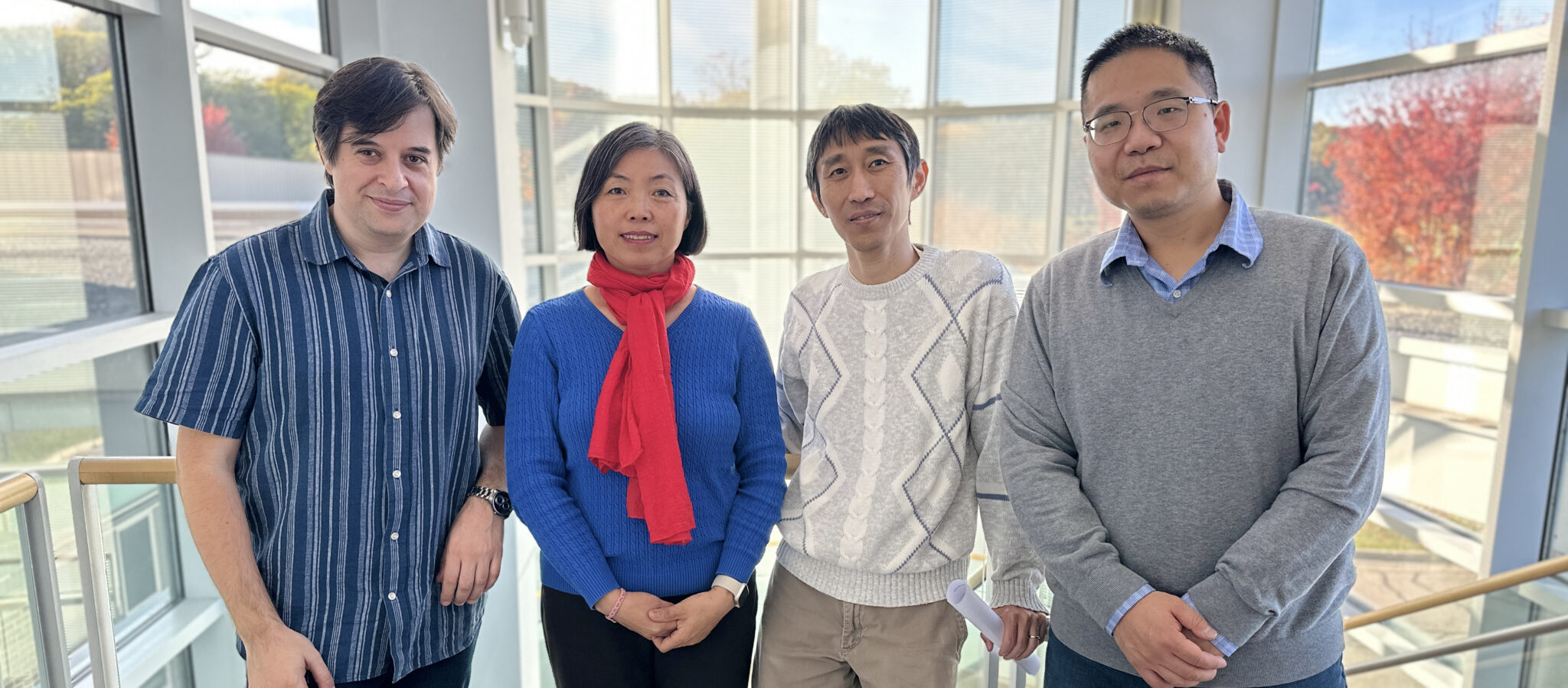
From left to right: André Sousa, Xinyu Zhao, Qiang Chang, and Daifeng Wang
UW–Madison Deans Discuss AI Impact, Collaboration During Summerfest Tech Event
Artificial intelligence is rapidly emerging as a paradigm-shifting technology, with wide-ranging (yet often unclear) impacts on education and beyond. It’s a moment unlike any other in history, but it’s also a moment UW–Madison is seeking to meet through innovation, collaboration, and a dedication to improving lives.
That was the message delivered by three of the university’s deans during the Badgers in Tech: Shaping an AI-Driven Future event in Milwaukee, hosted in conjunction with the Summerfest Tech conference. The event—organized by the Wisconsin School of Business, College of Engineering, and new College of Computing & Artificial Intelligence—was the culmination of a three-city tour, with previous stops in San Francisco and Chicago.
During a wide-ranging panel discussion, the three deans fielded questions from local tech professionals and alumni, provided insights into how their schools are approaching AI implementation, and discussed efforts to harness the technology to solve some of the most complex challenges facing Wisconsin, the nation, and the world.
Will AI Allow Us to Have More and Better Ideas?
By Emma Uren
The big promise of AI is that it will make us more creative. The concept is simple: give your tedious work to AI so you have time to be creative and generate big ideas. Sik Chung, assistant professor of management and human resources at the Wisconsin School of Business, is assessing whether this promise will actually deliver.
“Thanks to generative AI, many people now fully automate repetitive, tedious tasks without pausing to reason about it. My research suggests that doing so can quietly cost them the expertise that makes their ideas useful.”
UW-Madison engineers design ultra-stable composites for future space telescopes
By Tom Ziemer
Four years ago, the challenge NASA set before Ramathasan Thevamaran was—to put it lightly—considerable. As part of its 2022 Early Career Faculty awards, the agency solicited proposals to create composite materials capable of maintaining exceptional dimensional stability amid the extreme temperature changes encountered in space.
Just how stable?
The current state-of-the-art standard for such materials in terms of coefficient of thermal expansion (the value of how much their size changes in response to temperature variance) is measured in parts per million per Kelvin—meaning a 1-meter rod could expand or contract by 1 micron (one-millionth of a meter) for every degree change.
In contrast, NASA’s charge to researchers was to devise materials that could hold their shape when measured in parts per billion per Kelvin.
Oh, and the material also needed to be stiffer than stainless steel.
“This is an exceptionally challenging problem,” says Thevamaran, the Bernard A. and Frances M. Weideman Associate Professor of mechanical engineering at the University of Wisconsin-Madison.
Over the past four years, Thevamaran’s research group has worked steadily toward that goal, with the first step being designing such a material. To do that, though, the team needed to develop a framework for design and fabrication, which it published in a paper in the journal Composites Part B: Engineering. The paper, with postdoctoral research associate Yasara Dharmadasa and PhD student Paranjoy Basak as joint first authors, is the first in a series that Thevamaran’s group will publish to demonstrate its progress on the project.
WSB Professor Jordan Tong Authors Harvard Business Review Feature
A new article in the September-October 2026 issue of Harvard Business Review (HBR) suggests that, for many organizations, the biggest AI bottleneck lies not within individual tasks but between them—in the handoffs and decisions that cross organizational units. Jordan Tong, Robert M. Steiner Chair in Business and a professor of operations and information management at the Wisconsin School of Business, and co-author Kris Johnson Ferreira of Harvard Business School, explore how agentic AI orchestration systems can connect work across functions and integrate human input.
Freshwater@UW students complete a summer of research & discovery
Water@UW-Madison‘s cross-site, interdisciplinary research training program, Freshwater@UW, recently wrapped its fifth successful summer. This year, 29 outstanding undergraduates from 23 universities participated in nine weeks of immersive mentored water research.
Students were paired with mentors across seven UW institutions, including 14 students placed here at UW-Madison. They worked toward solutions in PFAS remediation, watershed restoration, hydrology and flooding, climate change, and more. The program is a powerful engine for the Wisconsin Idea, helping to refine student curiosity into knowledge, aptitude, and preparation for research that serves the public good.
UW–Madison and Green Bay-area partners build flood resilience along the East River
By Rodee Schneider
The creation of the East River Collaborative brought Wisconsin Sea Grant together with The Nature Conservancy and NEW Water, the brand of the Green Bay Metropolitan Sewerage District, along with municipal, state, federal and university partners spanning the watershed. Sea Grant’s role has been to provide the coordinating capacity, technical assistance, research and community engagement that local officials need to make good decisions for their own communities.
CQCI Leads the Way in Training Next Generation of Imaging Scientists at PAIR-UP Workshop
The Quantitative Cell Imaging (CQCI) in the Office of the Vice Chancellor for Research recently hosted some of the nation’s brightest young imaging scientists at an intensive workshop dedicated to advanced microscopy and professional development. Designed to expand and strengthen the scientific imaging workforce, the Partnering to Advance Imaging Research (PAIR-UP) program provided early-career researchers with hands-on experience with state-of-the-art microscopes, quantitative image analysis tools, and mentorship.

The PAIR-UP program is supported by major philanthropic organizations, including the Gordon and Betty Moore Foundation, the Chan Zuckerberg Initiative, and the Burroughs Wellcome Fund. This PAIR-UP workshop focused on hands-on activities, advanced learning, and robust community building for the participants.
Assistant UW Cell and Regenerative Biology (CRB) Professor and CQCI faculty member Abhishek Kumar played a central role in organizing this event, in collaboration with CQCI Director, Morgridge Investigator and Professor of Medical Physics Kevin Eliceiri and Randy Bartels (Morgridge Institute for Research and professor of biomedical engineering).
Latest Center for Healthy Minds Study Aims to End the Trial and Error of Mental Health Care
$6.6M study to use real‑time signals from your daily devices and body to predict who may benefit from mental health interventions – within days and even hours.
Over 1 billion people worldwide live with a mental health condition, but only 7 out of 100 people actually get treatment — typically medication and/or therapy or counseling. From the start of treatment, much of the process is trial and error, leaving people caught in the current system that assesses mental wellbeing treatments through subjective self-reports.
Yet, wellbeing tools like the Healthy Minds Program (HMP) — a free app by Humin based on the Healthy Minds Framework — can shift wellbeing within days, while standard questionnaires are collected every few weeks. Early improvements can go unseen, with no way to know who will benefit or who may be at risk of worsening. What if there were a more timely, nimble and accurate way to measure people’s mental wellbeing to understand when treatment starts working and for whom?
A multi-disciplinary team of University of Wisconsin–Madison researchers, led by the Center for Healthy Minds (CHM) and the Wisconsin Institute for Discovery (WID), is set to expand an on-going study dedicated to exploring this question.
Center for Healthy Minds Shares Crucial Findings of No Symptom Worsening Following Mindfulness-based Cognitive Therapy
Researchers from the University of Wisconsin–Madison’s Center for Healthy Minds (CHM), along with UW–Madison Department of Educational Psychology and a multi-university team, have released findings of no evidence that mindfulness-based cognitive therapy (MBCT) increased a risk of symptom worsening, in a meta-analysis published in JAMA Network Open.
MBCT is a widely-adopted, evidence-based intervention, used to help people with recurring depression from relapsing.
Community Wisdom is Transforming Wellbeing Initiatives and Research
Collaborations between Wisconsin community members and Center for Healthy Minds highlight the power of initiatives and research grounded in trust, listening and lived experience.
Aaron Hicks didn’t have it in his plan to build and advise research at the Center for Healthy Minds (CHM). Dekila Chungyalpa didn’t know she’d lay the groundwork to create a documentary film for and by Indigenous people. And, Dan Grupe and Christy Wilson-Mendenhall didn’t realize they’d regularly participate in mindfulness groups that help sustain community research projects with justice-impacted people. Yet, all of these things are central to the rigor, reach and impact of their work at CHM.
UW–Madison Study Highlights Refugee-Engaged Research and Community Change
A new journal article co-authored by Matthew Wolfgram, a researcher at the Wisconsin Center for Education Research (WCER) in UW–Madison’s School of Education, argues that participatory action research offers a powerful and ethical framework for engaging refugees in higher education and improving services for refugee communities.
Published in Cultural and Pedagogical Inquiry, the article — “Participatory Action Research as a Pedagogical Framework for Refugee Engagement in Higher Education” — examines two classroom-based studies that placed refugee community members at the center of research design, storytelling, and advocacy.
New Study Examines How Educators and Advisors Support HMoob Students in STEM Amid Changing Political Climate
Researchers from the Wisconsin Center for Education Research (WCER) at the UW–Madison’s School of Education and partner Universities of Wisconsin campuses have published new findings that explore how instructors and advisors support HMoob (Hmong)* students in STEM fields amid changing political and institutional conditions.
The new study, “Researching, Advising, and Teaching During Precarious Times: Insights from a Racial Equity in STEM Education Research Project,” published in the ADVANCE Journal, examines the experiences of educators and advisors working to support HMoob students and other historically marginalized students in higher education, offering insight into the challenges, tensions, and opportunities shaping student success in STEM fields today. Researchers drew on interviews with STEM instructors and advisors across four Universities of Wisconsin campuses, as well as reflections from members of the research team.
The study is part of the National Science Foundation-funded Our HMoob American College Paj Ntaub project.
UW–Madison Researchers to Partner with Parents of Black-Jewish Children in Bid to Boost Student Belonging in Early Childhood Education
A study team led by UW–Madison education researcher Michal Avera Samuel will use a $45,300 private grant to examine how parents of Black-Jewish children support identity and belonging in early childhood — with findings to help Jewish educators build more inclusive and affirming learning environments for pre-kindergarten through first grade students.
Researchers expect practical guidance generated by the study to help Jewish early childhood educators create curricula, professional learning, and family engagement strategies that are more welcoming. The work will help address a critical lack of education resources that reflect increasing racial and ethnic diversity in the Jewish community.